On Monday, April 3, the Cocoa, Forests and Diversity Agreement 2026 Action Planning Workshop was held at the offices of Conservation International. The objective of the workshop was to evaluate the progress of the implementation of the Agreement's Action Plan, and to plan future actions, taking into account the new context that includes the upcoming entry into force of the European regulation on imported deforestation.
The event was organized by Solidaridad, as technical secretariat, the Tropical Forest Alliance and the Business Alliance for the Amazon, an integrative platform promoted by the United States Agency for International Development (USAID), the Government of Canada and Conservation International.
The Agreement Cocoa, Forests and Diversity promotes the differentiation of Peruvian cocoa as sustainable, high quality and free of deforestation. This collective action agreement unites the sector to position our cocoa and face the demands of the international market, caring for the forests and improving the quality of life of producers. Today it is driven by the Coalition for Sustainable Production
The Coordinator of the Coalition for Sustainable Production, Fabiola Muñoz, gave the welcoming remarks and stressed the importance of working together as a sector to face the new international market regulations and take advantage of this context as an opportunity to conserve forests.
For her part, the Coordinator of the Cocoa, Forests and Diversity Agreement, Angélica Fort, presented the progress of the Action Plan 2021 - 2024The company also emphasized that priority was given to the issues of monitoring and traceability of non-deforestation in order to respond to new market demands.
During her intervention, the Agreement Coordinator invited Yovita Ivanova from the Bioverstity CIAT Alliance to expand on some of the advances such as the Proposal for a reference year for voluntary commitments for deforestation-free production in the Peruvian Amazon.aas well as the Technical Guide for the use of Global Forest Watch Pro for monitoring deforestation.
On the side of the producers' cooperatives, Pamela Esquivel from ACOPAGRO intervened to present the Traceability pilot with Proforest. In its initial stage, the pilot seeks to obtain a diagnosis of ACOPAGRO as an association, understanding the functioning of its supply chain, its policies, commitments, gaps, customers and future plans for market expansion.
Daniel Coronel from TFA presented the training plan, which began with a Global Forest Watch Pro workshop with technicians from companies and cooperatives in Lima and will soon be developed in Ucayali and other regions of the Amazon.
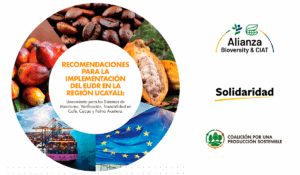
Finally, Ada Lis Rosell from Solidaridad presented the Study on the impact of the EU Green Pact on the coffee and cocoa sectors and identification of measures to mitigate the negative impacts. She emphasized that the collective work of the sector is becoming urgent and important in the face of the new demands of the European Union regulation on deforestation-free commodities.
The second part of the workshop consisted of reaching consensus on the priorities to be included in the 2023 - 2026 Action Plan, defining the main products by priority and identifying stakeholders committed to the development and implementation of the roadmap by priority.
With the participatory work in plenary and in groups by priority, it was agreed to work on 5 priorities and work began on the roadmaps by priority, which will be completed in the coming weeks with the participation of private, public and civil society actors, including members of the Agreement and allies.
Priority 1: Legal framework to have regulations and procedures for the legalization of cocoa producers.
Priority 2: Traceability, monitoring and geo-referencing to have instruments for geo-referencing, monitoring and traceability of the non-deforestation of the farms of small cocoa producers.
Priority 3: Sustainable Production cocoa producers have a platform of services for sustainable, deforestation-free production
Priority 4: Incentives to have incentives for sustainable and deforestation-free cocoa production
Priority 5: Communication and advocacy peruvian cocoa maintains its markets and positions itself as sustainable and free of deforestation
The workshop was very well attended by the members of the Agreement. Twenty of the twenty-four members from the private sector, public sector and civil society were represented with an average of two participants each who actively participated in the construction of the 2026 Action Plan.
Milestones of the Cocoa, Forests and Diversity Agreement:
January 2022 - Validation of the Agreement's action plan +info
April 2022 - Presentation of the Agreement's action plan +info
August 2022 - Workshop for the exchange of experiences in traceability and monitoring of non-deforestation traceability. +info
November 2022 -Event: Implications of the European regulation on deforestation in the coffee and cocoa agricultural chains +info
March 2023 - Workshop on how to use the Global Forest Watch Pro tool for the traceability of deforestation-free production. +info