Peruvian exports, mainly coffee and cocoa, to Europe could be seriously affected if the country does not adapt to ensure deforestation-free production. In 2021, agricultural exports to the European Union reached US$3,261 million. That year, nearly 40% of cocoa and 50% of coffee exports were destined for the EU.
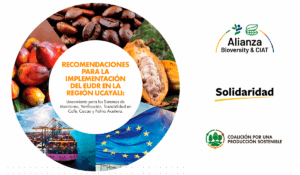
The European Commission has taken important steps to regulate the import of tropical agricultural products in terms of their environmental and social standards. According to the European Parliament's website/span>, it is a legislative proposal that aims to curb deforestation and forest degradation associated with the production of coffee, cocoa, oil palm, timber and soybeans.
The conference "Implications of the European regulation on deforestation in the coffee and cocoa chains" was held on Friday, November 18, in order to provide guidance and guidelines to the actors in the value chains affected by this new regulation. The conference was attended by the specialist Gert Van der Bij, Senior Policy Advisor of the European Union, from Solidaridad, and the Minister of Production, Jorge Prado Palomino.
Below, we share the 9 main points on the European regulation, summarized in this conference:
1. Countries will be categorized according to their risk associated with deforestation as low, standard or high risk countries.
2. According to the proposed regulation on imported deforestation, commodities to which the standard will apply must be deforestation-free, i.e. produced on land that has not been deforested since December 31, 2020; and legal, that means, produced in accordance with each country's production law.
3. Authorities of the EU member states will be responsible for the implementation. It may include fines of up to 4% of the turnover of the company's products concerned in the European Union.
4. The information requirement to be provided by the operator entering the products into the European Union is as follows:
- Geolocation coordinates (latitude and longitude) of all farms and lands where commodities and products are being produced, as well as the time of production. European Union officials will use satellite monitoring for verification.
- Information to ensure that the products are free of deforestation (Forests: more than 0.5 ha; trees over 5 meters high and more than 10% of Canopy species).
- Information that the production has been made respecting human rights, in accordance with local legislation.
5. Companies importing products into European markets will need to prove that their raw materials comply with the regulation.

6. This regulation will be complementary to the Sustainable Corporate Governance (SCG) legislative initiative, which aims to improve the European Union's regulatory framework for corporate policies and corporate governance. The regulation generated from the SCG will focus on a more horizontal approach regulating human rights issues and environmental impacts, under the approach of corporate behavior. On the other hand, deforestation-free regulations will focus on specific products and value chains. The two initiatives are mutually influential, and the specific objectives are different.
7. It is expected that the political institutions of the European Union will agree on the regulations by the end of the year, December or early 2023. This will be followed by an implementation period of 12 to 18 months.
8. There is a risk that regulation creates incentives not to buy from areas where there is a risk of deforestation or not from vulnerable smallholders who have more difficulty demonstrating compliance. Action is needed to prevent this from happening:
- Advocating for adequate regulation and accompanying measures, and
- Ensuring that actors are prepared
9. Producers and marketers must be prepared to:
- Mapping the implications of the bill on their supply chains and working on a joint agenda to address them.
- Work on building relationships in the supply chain and support farmers and cooperatives to meet the requirements.
- Ensure that smallholder farmers earn decent incomes while maintaining forests, through agroforestry, carbon sequestration and emission reductions.

- The conference included the participation of important panelists representing the public and private sectors:
- Mr. Luis Martin Mesones Odar, Vice-Minister of Mype and Industry, PRODUCE
- Ms. Mariela Amemiya Siu, Director General, General Directorate of Foreign Trade Development Policies, MINCETUR
- Minister Ricardo Silva-Santisteban, Director for International Negotiations, Ministry of Foreign Affairs
- Mr. Jorge Isaul Moreno Morales, Director General of Agricultural Development and Agroecology, MIDAGRI
- Mr. Luis Mendoza, Manager, APPCACAO
- Mr. David Gonzáles, Project Coordinator, Peruvian Chamber of Coffee and Cocoa
- Mr. Gonzalo Ríos, General Manager, ACOPAGRO
Receive a notification when the video of the conference with subtitles is available by writing to diana.wu@solidaridadnetwork.org .
The meeting was organized by the Coalition for Sustainable Production, Solidaridad, TFA, ADEX and the Business Alliance for the Amazon, a platform promoted by USAID, the Government of Canada and Conservation International, in the framework of the Cocoa, Forest and Diversity Agreement (an initiative of the Coalition for Sustainable Production).