Cocoa, Forests and Diversity Agreement boosts responsible production of Peruvian cocoa to enter European markets
The agreement is promoted by the Coalition for Sustainable Production, a multi-stakeholder platform that seeks to respond to the sustainability demands of the market and contribute to the fulfillment of Peru's climate commitments.
The initiative seeks to position and reinforce Peru's differentiation as an exporter of quality cocoa, with verified attributes of origin and free of deforestation by 2025.
Europe is the largest importer of cocoa beans in the world, with 61% of world imports. Likewise, in Peru alone, during the first half of 2021, exports of cocoa and its derivatives achieved a growth of 9% compared to 2020, totaling more than US $150 million in revenues, according to the Exporters Association (ADEX).
In response to this growing demand and to the new demands of the European market to curb the production of products that come from deforestation of the forests, the Coalition for Sustainable Production has been promoting the Cocoa, Forests and Diversity Agreement, an initiative that seeks to promote sustainable cocoa production through processes that respect the Amazonian forests by 2025.
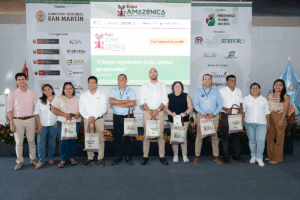
From left to right: (1) Gustavo Suarez de Freitas, Executive Coordinator of Earth Innovation Institute; (2) José Iturrios, National Director of Alianza Cacao Perú; (3) María Paz Montoya, USAID Peru; (4) Isabella Genta, USAID Peru; (5) Anaximandro Rojas Gil, President of APPCACAO; (6) Gonzalo La Cruz, Regional Director for South America of Solidaridad
The agreement brings together about 20 members from companies, producer associations, an exporters' guild, international cooperation and government institutions.
The Coalition for Sustainable Productionis a multi-stakeholder platform that promotes Peru's global leadership in tropical agriculture and territories that guarantee deforestation-free and low-emission production. The implementation of this agreement, which dates back to 2021, will be the responsibility of all its members. SolidaridadThe Agreement's technical secretariat, with support from TFA and USAID, is provided by the leading international supply chain development organization.
Likewise, this commitment is made by 20 organizations of the cocoa value chain in Peru, including the Ministry of Agrarian Development and Irrigation (MIDAGRI), ACOPAGRO, Amazonas Trading Peru, APPCACAO, the Exporters Association (ADEX), the Peruvian Chamber of Coffee and Cocoa, Colpa de Loros, Cooperativa Agraria Allima Cacao Ltda, Kaoka, ROMEX, Alianza Bioversity - CIAT, Alianza Cacao Perú, Climate Focus, Earth Innovation Institute, Earthworm Foundation, Lutheran World Relief, MDA - GCF TF, Rainforest Alliance, Rikolto, Solidaridad and Tropical Forest Alliance.
In order to produce sustainably, less forest-intensive and more technology-intensive production is urgently needed.
Presentation of the Action Plan
The objectives and actions of this commitment are contemplated in theAgreement Action Plan which identifies five priorities: determine the reference year for monitoring deforestation in cocoa, establish tools for monitoring and traceability of deforestation-free cocoa, launch a platform of services to support deforestation-free production, apply the development of incentives to producers for sustainable productive reconversion and implement communication strategies.
To communicate the progress made by the participants, the Agreement's Action Plan was presented on Thursday, April 21, attended by representatives of the private sector, civil society and government.
The members of the Agreement were accompanied by representatives of public agencies such as DEVIDA, the Ministry of the Environment and SERFOR; companies such as La Ibérica; and the Latin American Guarantee Fund FOGAL.
Also present were the Swiss Cooperation - Seco and representatives of the USAID delegation in Peru. As for international delegations, there were participants from the British Embassy, the European Union and the Kingdom of the Netherlands, represented by its Ambassador to Peru, Mrs. Nathalie Lintvelt.
Learn more about the agreement's action plan in this video
Members of the agreement speak
"For cocoa producers, we believe that (the agreement) is in line with the global context, which is occurring in the sector and especially with organic production standards and sustainable production standards. I believe that all of us who work in the chain are committed to the development of the sector, without causing damage to the environment, especially deforestation. But we are also aware that this new regulation means a series of challenges for countries, institutions and especially for producers".
If we really want to demonstrate to the international markets of the European Union, the United States and the United Kingdom, we must have a reference year for monitoring cocoa deforestation.
"Sustainability for us is not a commercial issue; it is in the DNA of our companies. It must be immersed in the organizational culture of the export sector and in the production culture of our cooperatives.."
"We are one of the most united chains that works with a common vision and I think that is what has allowed us to achieve the most important challenge we face in the next half century, and here we face a complicated challenge: 20 years ago, the average size of cocoa production of a producer was about half a hectare; today it is more or less three hectares. We have had a more forest-intensive and less technology-intensive production and I think that is the challenge we face going forward".
"The public sector is also committed to joining this initiative (the agreement). Proof of this is that in this planning process for the development of the cocoa and chocolate value chains, the commitment to deforestation-free cocoa has been considered within the framework of the Cocoa, Forests and Diversity Agreement, which is already part of the National Action Plan for Cocoa and Chocolate Development."
Exhibition of member companies' products
After the presentations, attendees were able to appreciate and take away chocolates and other cocoa products from the exhibition table, in which members of the Amazonas Trading Agreement, Allima Cacao Cooperative, MIDAGRI, the Cacao Peru Alliance and Rainforest Alliance participated. Learn about their products and initiatives below: