Continuing with this Dialogue, at the V Latin American Cocoa and Chocolate Forum, and also in the framework of the Cocoa, Forest and Diversity Agreement, were held the following conferences: "Challenges of Sustainable Amazonian Cocoa in the face of international regulations" y "The European No Deforestation Standard: Challenges for the Peruvian cocoa sector".Both forums were well attended by the attendees, including members of the Agreement and other representative actors of the national and international cocoa sector, private, public and civil society.
The first forum: "Challenges of Sustainable Amazonian Cocoa in the face of international regulations" had the participation of Angélica Fort, Manager of Sectoral Agreements for Sustainable Production at Solidaridad. In this panel she was invited to discuss the progress made by actors and platforms in Peru to face the EU regulatory challenge in the cocoa chain.
She began by mentioning the anticipated work of the Cocoa, Forest and Diversity Agreement in relation to the commitment of its members to not deforesting and developing monitoring and traceability systems. With the official launch of the European regulation this year, they have updated their Action Plan and, since the Coalition for Sustainable ProductionThe unions are working on proposals to modify the legal framework and land formality issues. On the other hand, she indicated that the unions have been key to exert pressure and to make the State feel the urgency of taking action. In this regard, MINCETUR called on the World Bank to develop a Road Map to guide the public sector in its policies regarding this regulation. In the case of civil society, it has been working on its own pilots and testing small-scale technical assistance, monitoring and traceability experiences in order to scale up the most successful ones.
Fabiola Muñoz, coordinator of the Coalition for Sustainable Productionconcluded in this forum that deforestation is an economic decision associated with poverty and that it is important to understand the context and how illegal economies play an important role. She stressed that this is not the time to look for culprits but to work together to combat the major challenges of climate change and poverty. Seeking this sense of unity and within the framework of decentralization, she stressed the importance of including regional authorities, who are one of the main actors in implementing regulatory measures, as soon as possible.
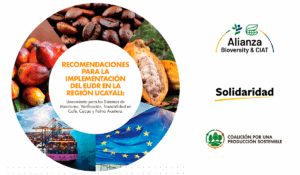
For its part, the second conference: "The European No Deforestation Standard: Challenges for the Peruvian cocoa sector" was moderated by Angelica Fort, coordinator of the Cocoa, Forest and Diversity Agreementwho introduced Marjoleine Motz, a consultant from Fair & Sustainable Consulting, to present the preliminary findings of the "Ex ante research on the impact of EU deforestation regulation on the coffee and cocoa sector in Peru and identification of measures to mitigate the negative impact.".
This is a study that, under the framework of priority 5 of the Agreement related to Communication and Advocacy, has been finalizing details to determine the impacts and measures for action in the face of the new European no deforestation regulations.
In her presentation, Marjoleine Motz highlighted the efforts of the Cocoa, Forests and Diversity Agreement, which since 2021, seeks to position Peruvian cocoa as high quality, single origin, sustainable and free of deforestation, proving to be a multi-stakeholder platform for dialogue, commitment and action.
In this regard, a panel with representative actors of the cocoa sector was invited to the stage. The private sector was represented by Gonzalo Ríos, General Manager of ACOPAGRO and Camila Olmedo, Regional Sustainability Manager of ECOM. The public sector was represented by Sonia Arce, General Director of the General Directorate of Agricultural Policies - MIDAGRI and Teresa Mera, Vice Minister of Foreign Trade - MINCETUR.
"I call on organizations, international cooperation and the State to work together to face these challenges that will arise in the coming years."
Gonzalo Rios General Manager of ACOPAGRO
"We need a tool and a methodology that is fairly democratized. But, if we continue to make funds to finance different projects with different tools, it's going to be very difficult to align ourselves to the time it takes to be able to meet the standard and demonstrate not only to European standards, but also to the client itself."
"We have to work on this not only because the European Union regulations require us to do so, but also because our own regulations require us to do so. And it is not only the European Union that has concretized this policy in a regulation; the United States and Japan, countries that are important for our exportable supply, are already on the way".
Sonia Arce Director General of the General Directorate of Agrarian Policies - MIDAGRI
"One of the biggest challenges...for our profile as an agro-exporting country in the different sectors...is the issue of titling...I believe that we should take this complex situation as an opportunity...because we need this lack of incentives to generate spaces for investment in the producers themselves".
Teresa Mera Vice-Minister of Foreign Trade - MINCETUR
"When I was here in May, in some interviews I felt that people knew about the regulation, but they did not feel the urgency...Today I feel that there is more coordination, willingness, effort to look for solutions and to divide between what is very urgent and what is necessary to create sustainable sectors".