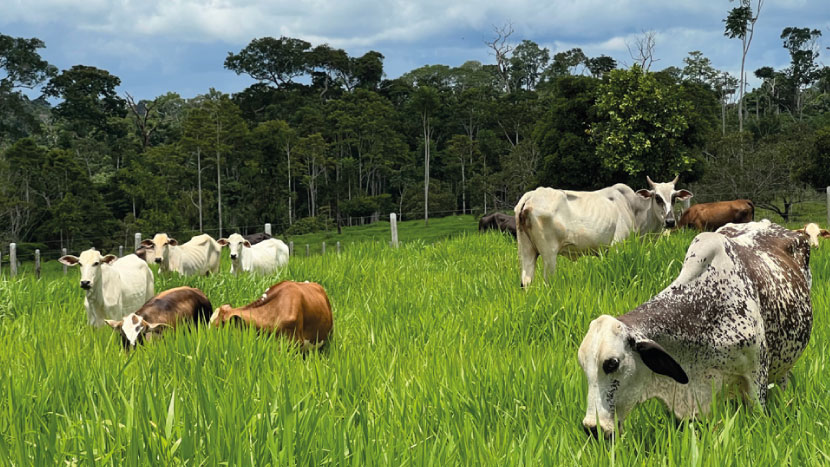
Peruvian Amazonian cattle ranching is a small and emerging sector with the potential to expand its scale on the basis of differentiation in quality, sustainability attributes and environmental responsibility, which will initiate a deforestation-free cattle ranching.
With this vision in mind, a prospective visit was made to Madre de Dios (Peru), where agricultural farms implementing regenerative livestock systems were visited in the district of Iñapari, Tahuamanu province, and the generation of a national community of practice was promoted, inviting the private sector, government and civil society. More than 25 key stakeholders from the livestock sector, belonging to 15 organizations, participated in the two-day program (December 9 and 10).

"This exploratory visit was useful to map opportunities in new areas of Amazonian beef production and identify actors working for responsible management of tropical cattle" - Renato Portillo, Commercial and Operations Manager, MAFROX.
"This study visit allowed us to learn about the productive characteristics and needs of Amazonian cattle ranchers in order to offer, in the future, irrigation solutions that increase efficiency in the use of soil and water"- Katherine Yong, Business Development Manager, Rivulis South and Central America.

Madre de Dios is a key territory for Amazonian cattle ranching in Peru because it has more than 25,000 hectares dedicated to cattle pasture management. This territory has a livestock credit program from Agrobanco (the Peruvian government's agricultural bank), and the National Institute for Agrarian Innovation (INIA), WWF and the Regional Government of Madre de Dios have programs that promote good sustainable livestock farming practices. There is also a space for dialogue and coordination through the institutional framework formed by the Mesa Técnica Ganadera (Livestock Technical Roundtable).
Currently, a program of rural field schools (ECAs) is being developed with livestock producers by WWF Peru, with the objective of strengthening capacities to improve livestock production through agroecologically based silvopastoral and rotational systems, with a focus on gender equity and social inclusion. Likewise, an alliance of public and private actors is being formed for regenerative livestock farming in the Peruvian Amazon, within the framework of the Coalition for Sustainable Production (supported by TFA).
The activity was carried out within the framework of the project "Promoting deforestation-free cattle ranching in Madre de Dios, Peru" implemented by WWF, The Climate Group and Tropical Forest Alliance; funded by the government of the United Kingdom through the UK PACT program.