Expoamazonica: Ten points on the urgency of implementing deforestation-free production in the Peruvian Amazon
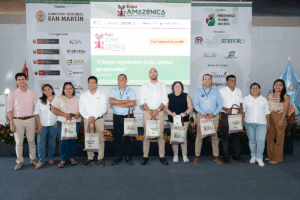
On Thursday, August 18, the Sustainable Amazon Forum was held as part of Expoamazonica 2022 in the city of Chachapoyas, Peru. In this space, members of the Coalition for Sustainable Production had the opportunity to exchange experiences and information in the block on "The potential of agricultural chains for the conservation of the Amazon forest landscape."
Here are some key ideas from the private sector, government and civil society on how to achieve deforestation-free agricultural production in the Peruvian Amazon:
1. With the complexity of the political environment, maintaining a strong shared agenda requires strengthening multi-stakeholder platforms such as the Coalition for Sustainable Production.
2.Global regulations, such as those related to deforestation imported from the European Union, require the urgent reconversion of production systems.
3. In order for production chains to demonstrate that they are deforestation-free, monitoring and traceability, producer financing and land ownership, among other minimum conditions, are needed.
4. We are late in starting the process towards deforestation-free production and it is urgent that producers understand that if they continue deforesting, international markets will not buy Amazonian production.
5. We have to start developing financial and non-financial incentives to develop a new way of farming, based on technology and not on expansion over forests.
Technical assistance is important to guide small producers towards production that can respond to new global regulations and future demand.
6. It is necessary to promote initiatives and business models that promote sustainability through financing, which requires the support of the private sector, the State and cooperation.
7. Multi-stakeholder agreements to mitigate deforestation, such as the Cacao, Forests and Diversity Agreement, the Alliance for Regenerative Livestock in the Peruvian Amazon and the Tocache Jurisdictional Initiative, contribute to the fulfillment of Peru's commitments under the Paris Agreement.
8. We must go beyond supply chains and think about complementary solutions, such as sustainable jurisdictions that allow for low deforestation risk supply zones and low-emission development.
9.Other standards must be improved, such as crop safety, the prohibition of chemical use and good labor practices. For example, the widespread use of chemical products undermines the competitiveness of Amazonian production, which focuses on quality.
10. If the value of natural capital is made visible, complementary businesses will appear that will be able to support small producers and generate more cash flow for the productive units.
The Coalition for Sustainable Production faces the great challenge of promoting sustainable investments and urgently contributing to the competitiveness of value chains in international markets. To this end, it is important for the government to commit to supporting and promoting multi-stakeholder spaces for the generation of public policies in line with the case. Today, it is a platform that brings together nearly 50 organizations committed to promoting deforestation-free agricultural production and has taken great strides in the last three years to generate commitments and set an agenda for action.
As soon as the world stabilizes from the war with Ukraine, prices and demand will stabilize. For the producer, this means cutting more forest and planting. We have to start developing incentives to change the way cocoa has been grown, making it more technology intensive.
The latest standards coming out of the European Union, such as zero deforestation, are not yet defined. [...]. We, as Acopagro, make controls and follow-ups, but what if other organizations or regions do not do the same, then we would lose an opportunity to export to the European Union.
The work must be collaborative and articulated and, undoubtedly, in the case of production chains, it is important to articulate with a landscape approach, which shows us the mosaic of the different productive activities.
As soon as the world stabilizes from the war with Ukraine, prices and demand will stabilize. For the producer, this means cutting more forest and planting. We have to start developing incentives to change the way cocoa has been grown, making it more technology-intensive.
Today, the market is giving signals that it wants to ensure that any product that is purchased does not come from a chain where deforestation has been part of it. We are not prepared to make that leap (...) Without technical assistance and financing, it is going to become a major problem.
This dialogue was organized by the Coalition for Sustainable Production, with the support of the Tropical Forest Alliance, SolidaridadEarth Innovation Institute, Earth Innovation Institute and Alternative Development Mechanisms (GCF Task Force).
The Coalition for Sustainable Production has the great challenge of promoting commitments, actions and an appropriate business environment to contribute, as a matter of urgency, to the competitiveness of value chains in international markets.