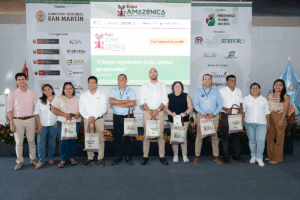
On Wednesday, November 4, the Coalition for Sustainable Production held a meeting for the exchange of experiences: opportunities for the sustainable competitiveness of the palm in Peru, Colombia and Central America. The purpose of the dialogue is to share the progress of the multi-stakeholder platform to achieve a palm sustainable and free of deforestation.
The main countries that produce palm Latin American countries are adopting implementation agreements and best practices to adjust their production systems to free deforestation and achieve sustainable development. sustainable. Through the participation of the National Federation of Oil Palm Growers of Colombia (Fedepalma), we reviewed the experiences of Colombia, Guatemala and Honduras; Solidaridad united to comment on the experience of Honduras; and the Association of Palm Growers of Guatemala (Grepalma).
A key aspect of the dialogue was to identify the positions of the Peruvian palm-growing sector in this scenario. Therefore, the main Peruvian players such as Grupo Palmas, Alicorp, Junpalma and the Regional Government of Ucayali (a region that is one of the main production areas in Peru) gave their points of view on how the Peruvian palm-growing sector should respond to this market challenge.
The main point of the dialogue is to be able to determine the state of the Peruvian palm industry. Thus, the main players in Peru, such as Grupo Palmas, Alicorp, Junpalma and the regional government of Ucayali (the region is one of the main areas) presented their views on how the industry should be able to face this challenge in the market.
Private Sector: Towards a certified, sustainable and inclusive oil palm
According to Sandra Doig, Sustainability Manager of Grupo Palma, a leading company in the production of palm oil mill In Peru, the market has a tendency towards more fats and the demand for oil is growing with the growth of the economy and the middle class, and in this scenario, challenges emerge as to how to meet this demand without putting pressure on the forests.
As stated by Sandra Doig, Sustainability Manager of Grupo Palma, a leading company in the production of palm oil mill In Peru, we can currently appreciate that there is a marked trend towards more fat, thus increasing the demand for oil. Thus, new challenges appear that imply greater demand but that must be transferred to decrease the pressure of the forests.
"A company like Grupo Palmas, which has 26,000 hectares of oil palm consolidated in two plantations, could make the decision not to grow any more, not subject itself to any risk of deforestation, and operate at maximum productivity."
But, Doig explained:
"This view does not add value to the Amazon. That look is to put aside a reality where there are poor producers, that there are producers who plant palm with low or high productivity and that there is a permanent deforestation that subjects them to poverty".
For this reason, the strategy to be implemented includes increasing the production of palm The company will seek to ensure that suppliers comply with non-deforestation measures by training them and providing them with technical assistance in compliance with the sustainability standards followed by Grupo Palmas.
Alicorp, through Magdalena Morales, Vice President of Corporate Affairs, explained that it has been working for some time with small farmers under the slogan "Feeding a better tomorrow".
This strategy has as its main commitment to focus on the promotion of palm oil mill sustainable under the "Sustainable Palm Leaders" program.
"We believe that this is a joint effort," explains Morales. "In our case, we have been working hand in hand with our suppliers, so that they can identify sustainability gaps, and with that they can move forward, with plans, to close them. We have launched an inclusive program for the agricultural leaders of the extractors and producers to develop these capacities together with (the organization) Solidaridad and Nest.
These opportunities for dialogue are promoted by the Coalition for Sustainable Production; bringing together companies, civil organizations, entities and certain government sectors, generating alliances, helping and accompanying levels of government.
Néstor Sánchez, representative of Junpalma, said that it is important to educate producers, because if they themselves do not know about sustainability and its importance, the work will be difficult, so technical assistance and support with public policies is a necessity.
Finally, Vicente Núñez, Manager of Economic Development of the Regional Government of Ucayali, commented on the social conditions in which the palm was born in Peru, the evolution of the current producers of palm oil in Peru, and the evolution of the palm oil industry in the region. palm who were previously engaged in coca cultivation. Thus, there is a need for access to financing and the support of regional governments.