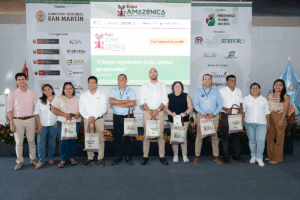
The regions of the Peruvian Amazon already have jurisdictional sustainability strategies. To support the implementation of these strategies, the Coalition for Sustainable Production (with the support of TFA) has identified the Alto Huallaga territorial unit (San Martin), one of the main cocoa and palm oil producing areas in Peru, as a model area to connect deforestation-free production commitments with concrete actions in the landscape.
This intervention model implies the articulation of stakeholders towards a shared vision of their territory, a long-term public-private governance, performance monitoring scheme, knowledge management and, most importantly, designing and mobilizing resources to implement instruments that generate concrete changes in land use and forest conservation. Similar initiatives are being designed by Coalition members in other territories in Ucayali and San Martin.