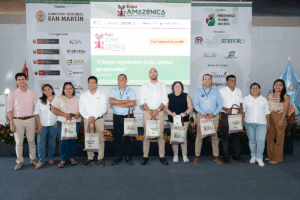
The workshop "Towards a Shared Agenda for Regenerative Livestock Production in the Peruvian Amazon" was held last Friday, March 18, 2022, in order to gather contributions to build a shared vision and an action agenda that will allow us to collaborate together to improve productivity, sustainability and market access conditions for Amazonian livestock production in Peru.
This virtual workshop was attended by nearly 40 participants from government institutions, companies and livestock committees, cooperants and representatives of civil society. Presentations were made on sustainable livestock guidelines and pilots, as well as group discussions on good agroforestry and soil practices, genetic improvement and research, and market and financial incentives.
Participants participated in 3 working groups where they reflected on good agroecological practices on the farm and landscape, improvement of the genetic quality of livestock and associated research, and market and financing opportunities. The importance of knowledge management was recognized to establish a cultural change that requires information to make evident these changes in production systems in terms of environmental sustainability, as these changes also lead to better economic performance of the activity, which is what most interests the local livestock producer.
If we want the Amazon livestock industry to be competitive, to have a public position at the national level and to contribute to mitigation in the climate agenda, a mixed strategy of productivity and quality must be promoted.
The next steps include consolidating a shared vision and an action agenda within the Alliance for Regenerative Livestock in the Peruvian Amazon (AGRAP), promoting the articulation of collective interventions and opportunities in the Peruvian livestock sector, which implies a productive improvement of the current conditions of Amazonian livestock, promoting a livestock culture. The exchange of information and experiences related to Amazonian livestock farming, since it is necessary to strengthen the capacities of local producers, consolidate a livestock farming culture and the pilots of good practices in the field, as well as the systematization of experiences, in addition to providing organizational strength and governance to the alliance or community of practice.
**
Why regenerative livestock farming in the Amazon?
Peruvian Amazonian cattle ranching is a small and emerging sector with the potential to expand its scale based on differentiation in quality, sustainability attributes such as deforestation-free and environmental responsibility. Responsible cattle raising should also contribute to improving the social welfare and quality of life of the populations involved in the activity.
**
The event was organized by Tropical Forest Alliance (TFA), World Wildlife Fund Peru (WWF Peru) and The Climate Group (TCG), within the framework of the project "From Policy Design to Field Implementation: Promoting Sustainable Livestock Production in Madre de Dios, Peru", which is funded by the UK Government's Partnering for Accelerated Climate Transitions (PACT) program and implemented by the aforementioned organizations. The objective of the workshop is within the framework of the formation of a community of practice called Alianza por una Ganadería Regenerativa en la Amazonía Peruana (AGRAP), within the framework of the Coalition for Sustainable Production, of which TFA and WWF Peru are members.

"We need all the actors to be working in a coordinated manner. The change for a sustainable livestock farming in a joint work, and it will not be possible without the producers, so we need to provide them with tools and guidance to generate these changes."
Ethel Huamán
Specialist of the General Directorate of Livestock Development of the Ministry of Agrarian Development and Irrigation (MIDAGRI), Peru.
"We urgently need a cultural change, and the tasks to make it possible are at the technological level, at the economic level, because we need to promote and finance this change, at the social level so that the authorities and producers become aware of this change, at the political level so that decision makers can define and promote this activity, and at the institutional level to generate public policies so that the processes transcend over time.
Kennedy Farje Alva
Director, Agricultural Experimental Station "El Porvenir" of the National Institute for Agrarian Innovation (INIA) San Martín, Peru.
"It is important to coordinate the public sector, the private sector and civil society, and that we have common objectives and from each side we add our grain of sand to implement good practices in production chains, improving the quality of life of producers and having a friendly and healthy environment.
Nelson Gutierrez
Landscape Planning Specialist at World Wildlife Fund Peru Madre de Dios Branch
"From the Coalition we are absolutely committed to this important issue for our country, to promote joint and collaborative work on the issue of regenerative livestock. I had the opportunity to be in the internship we did in Madre de Dios, and I think we are making significant progress; but as mentioned at the beginning, this is one of the most important issues in the generation of Greenhouse Gas (GHG) emissions, so we must give it the priority it needs, and I think the participation of all of us today shows it".
Fabiola Muñoz
Coordinator of the Coalition for Sustainable Production, Peru