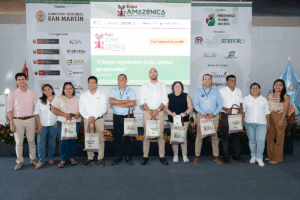
On April 6, the Coalition for Sustainable Production and the Tropical Forest Alliance organized the Sustainable Amazonian Cocoa Dialogue where the Cocoa, Forests and Diversity agreement was highlighted as part of the stakeholders' commitment to differentiate Peruvian cocoa based on deforestation-free production, product quality and genetic diversity and other attributes of origin.
According to MIDAGRI data, cocoa bean production in Peru has been increasing steadily for the past 10 years, at an average annual rate of 14 percent, with the participation of approximately 90 thousand small producers. In terms of cocoa exports, the growth rate over the last 10 years has been around 15.7 percent per year. However, it is also necessary to point out that, in some cases, cocoa cultivation is associated with deforestation in the Peruvian Amazon, although at the same time this crop has great potential to recover degraded areas.
"Within the framework of the Coalition for Sustainable Production, of which the Ministry of Agrarian Development is a member, the Forest and Biodiversity Sectoral Agreement has been developed in a participatory manner, where 11 leading organizations have joined" explains the Vice Minister of Family Agriculture Development and Agrarian Infrastructure and Irrigation, José Alberto Muro Ventura "The agreement proposes a coordinated work vision in favor of the differentiation of Peruvian cocoa."
In this context, the Sustainable Amazon Cocoa Dialogue was held with the objective of discussing with civil society, government and private sector actors how to move towards the implementation of the Cocoa, Forests and Diversity Agreement. This dialogue is also part of the initiative that TFA is undertaking to build a regional platform in Colombia, Brazil and Peru for deforestation-free cocoa in the Amazon.

"The challenge is that we want our cocoa to grow, to be more competitive, to position itself, but not at the expense of the forest" explained Fabiola Muñoz, Coordinator of the Coalition for Sustainable Production, who also highlighted the importance and privilege of having key government actors at the event, such as the two vice ministers of the Ministry of Agrarian Development and Irrigation and the president of the Amazon Regional Commonwealth. "It is not easy to find so many actors with that commitment, that is why the agreement that is being proposed on cocoa forests and biodiversity is an extraordinary opportunity (...). There is a sense of urgency that has to grow."
Cocoa, Forest and Diversity Agreement
The agreement is an example of collective action to improve the relationship between cocoa and forests, with positive social and economic implications.
According to José Yturrios, representative of Alianza por un Cacao Sostenible, the main commitments of the agreement are as follows:
- Deforestation-free supply chain by 2025
- Promote productive intensification and restoration of degraded areas.
- Incentive package and commitments for producers
- Positioning in the differentiated cocoa markets
- Monitoring and traceability
Luis Hidalgo, Governor of Madre de Dios, indicated that Amazonian governments have a commitment to make tropical agriculture and forest management competitive and sustainable sectors, necessary to respond to new global trade demands. "We must leave behind the old argument that forest conservation is opposed to economic growth".
Implementation considerations
During the dialogue on how we move to effective implementation in territories, the participants of the agreement mentioned the importance of promoting research as a prerequisite for optimal product quality. "The cocoa we have in our country has to be studied. There are some studies being done by many institutions for the characterization of genotypes by region, which easily surpass the productivity of introduced cocoa (...) we have to improve propagation systems, I think we have a very strong bottleneck there," explained Teófilo Beingolea, Project Coordinator of Rikolto Peru. "Undoubtedly we consider thinking about a sustainable and deforestation-free cocoa, for that there must be a strong traceability system (...) working on the issue of standardization, accreditation, methodology".
Global market opportunities and next steps
During the dialogue, the question was raised as to how we can obtain opportunities to boost local development in this context of demands for deforestation-free products from global markets.
Regarding these opportunities, Carmen Rosa Chavez, representing Midagri, indicated that Peru is currently the vice-president of the International Cocoa Organization, where a project is being implemented to deliver environmental bonds to producers and Peru has been chosen to implement it in three countries. She also explained that the challenge is to obtain a trust fund for the improvement of small farmers' farms.
Among the next steps is to involve more committed actors in the value chain and to announce it publicly to the country and internationally.
A second step is to define the priorities to see how it will be implemented, where different contributions will be needed to streamline the process. It is also necessary to identify the key regions to implement the pilots at the territorial level.