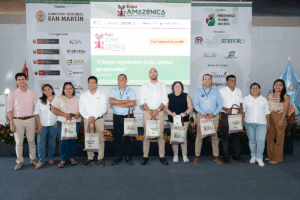
The Amazon Regional Commonwealth (MRA), with the methodological support of the Center for Strategic Planning (CEPLAN), the technical support of the Specialized Team of Executive Boards of the MEF, the Amazon Council of Chambers of Commerce, the Coalition for Sustainable Production, academia, civil society organizations and indigenous peoples' organizations, announced the beginning of the design of a Shared Vision for the sustainable development of the Peruvian Amazon. This effort constitutes the first step towards the elaboration of a integral development plan. The announcement was made during the 14th Annual Meeting of the Governors Group for Climate and Forests, held in Pucallpa on October 11.
The regions that make up the MRA, which cover 53% of the national territory and 90% of the country's Amazonian forests, face significant challenges, such as the historic loss of 10.5 million hectares of forest and the increase in informal economic activities. The Peruvian Amazon, home to approximately 4 million ethnically diverse people, has been historically marginalized and has low development indicators.
To date, Peru has not built a clear and structured vision of the desired future for the Amazon, one that reflects the aspirations of its population and is articulated with the country's integral development. With the Shared Vision 2050The MRA, and its subsequent development plan and deployment of strategic investments, seeks to address issues such as economic informality, low agricultural productivity and deforestation. At the same time, it will promote multilevel governance and the development of bio-businesses and other sustainable and inclusive productive activities.
The central objective of this effort is to formulate a Shared Vision and a Sustainable Development PlanThe initiative focuses on integrating key stakeholders, including the private sector, indigenous communities, civil society and academia, in order to achieve strategic planning that drives inclusive and competitive development. The initiative focuses on integrating key stakeholders, including the private sector, indigenous communities, civil society and academia, in order to achieve strategic planning that promotes inclusive and competitive development without compromising ecosystem conservation.
It is expected that this Shared Vision be presented at COP 2025, to be held in Brazil.