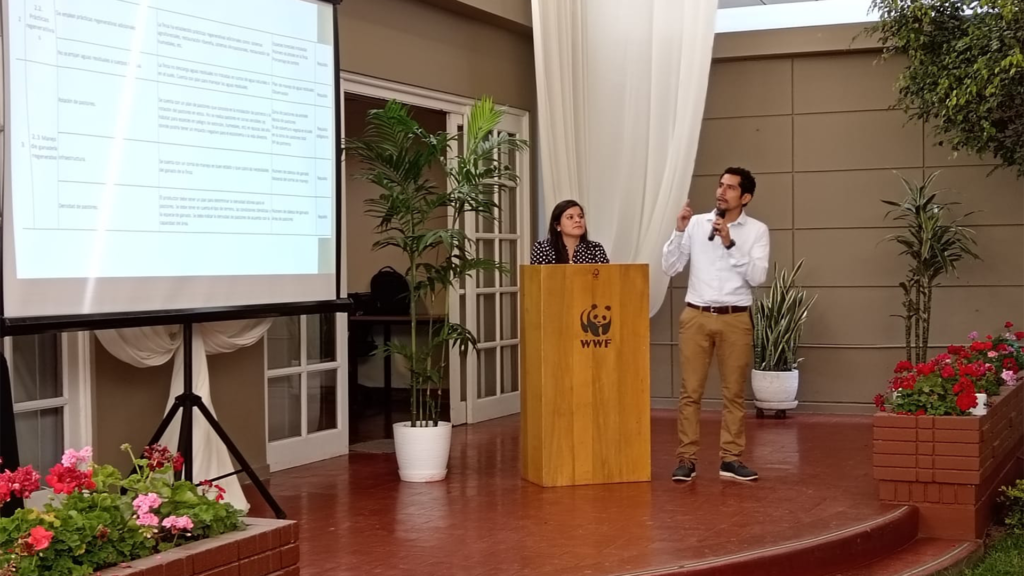
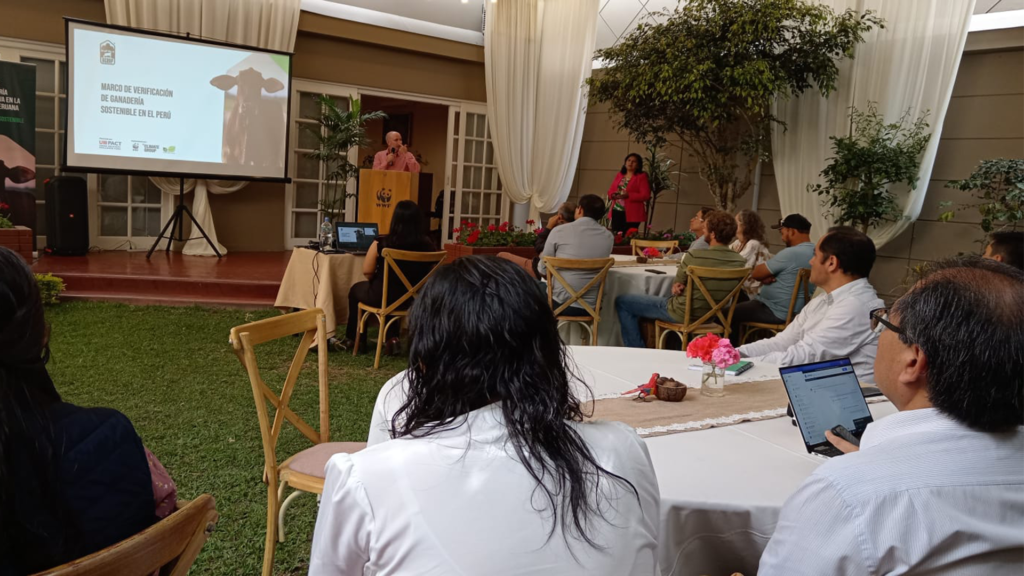
An important milestone was reached on Wednesday, November 22 with a workshop focused on the presentation and analysis of the beta version of the Verification Framework for Sustainable Tropical Livestock. The main objective of this meeting was to gather key recommendations that will drive the validation towards a participatory and consensual version. The event was attended by members of the Alliance for Regenerative Livestock in the Peruvian Amazon (AGRAP)The Verification Framework, together with experts and specialists dedicated to the modules proposed in the Verification Framework.
Why is the development of a Verification Framework relevant?
Under the initiative "From policy design to implementation in the field; promoting deforestation-free livestock farming"The project, executed by World Wildlife World (WWF), Tropical Forest Alliance (TFA) and Climate Group, with the support of the United Kingdom government through the UK PACT program, seeks to overcome limiting barriers to boost competitiveness and sustainability towards a regenerative and/or sustainable approach in Madre de Dios, with a view to impacting the entire Peruvian Amazon.
The process of constructing the Verification Framework was based on the crucial assumption that, in order to develop a market for sustainable and regenerative meat from the Amazon in Peru, it is essential to establish traceability instruments that make it possible to quantify/measure the good sustainable practices applied in a systematized and transparent manner, thus generating confidence in the entire production and manufacturing process of sustainable and/or regenerative meat products.
In a context where the Peruvian tropical livestock sector is in an initial phase of development, especially in terms of sustainability, the imperative need for a flexible instrument that establishes minimum standards and promotes continuous improvement has been recognized. This is in view of the fact that, during its implementation time, the project has managed to train an important group of farmers who already know about good regenerative and sustainable practices, for whom it is crucial to start measuring and making these efforts visible to the market. The verification frameworks comply with these characteristics, in addition to promoting and enabling continuous improvement to achieve the transition towards a desired horizon, in this case, the development of sustainable tropical livestock farming in the Peruvian Amazon.
Fundamental Objective: Design of a Comprehensive Verification Framework
The primary objective is to design a Verification Framework that is feasible, cost-effective, practical and based on scientific information, national policy and regional and global reference standards. This framework seeks to promote sustainable, deforestation-free and regenerative livestock supply chains, aligned with the Peruvian national context and validated by stakeholders.
In order to achieve this ambitious objective, several strategic actions have been carried out:
- Conduct an analysis and executive summary of the most relevant global and regional verification frameworks/standards/experiences on sustainable beef/livestock production, including lessons learned, challenges and recommendations.
- Interviews with experts and key players in the value chain, such as Midagri, Minam, meat packing plants, livestock producers' associations and experts from the Universidad Nacional Agraria La Molina (UNALM) and Open University, among others.
- Preparation of a first version of the structure and contents of the Verification Framework, on which to receive feedback.
- Organization of a workshop with livestock producers to validate the field applicability of the modules proposed for the Verification Framework, gathering feedback and potential modifications to the tool.
- Mock evaluation with the tool, in prioritized cattle farms, subjecting the tool to its application in the field.
- Elaboration of the beta version, gathering all the observations from interviews, workshops, field applications and others.
- Finalized beta version sent via e-mail to AGRAP members and other experts for their review and contributions.
- Workshop held on November 22 for the presentation and detailed review of the proposal.
This process of developing and validating the Verification Framework represents a crucial step towards the effective integration of sustainable livestock practices and environmental preservation in the Peruvian Amazon. We are moving towards a future where meat production and conservation coexist harmoniously, defining new standards in the Peruvian tropical livestock industry, in line with current global sustainability trends.